0
Kids Aren’t the Church of Tomorrow. They’re the Church of Today.
Share this Post
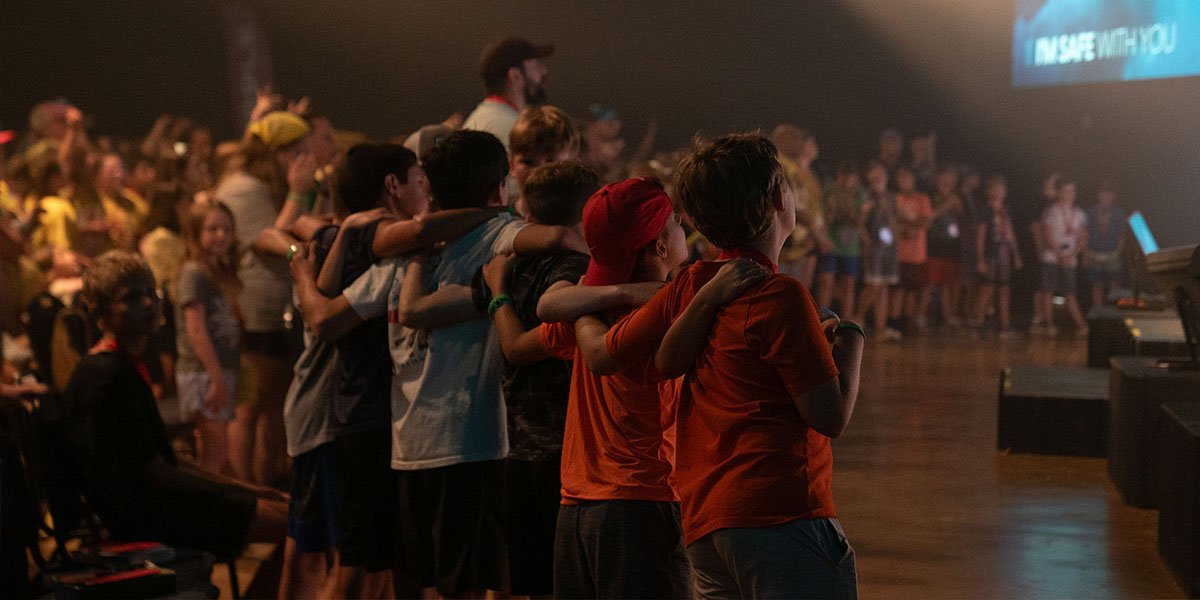
At one church where I served as a worship leader, we made a big deal of sending the kids out to children’s church in the middle of the service. As the band played a short, upbeat section of a song, the kids raced down the aisles and out to their venue. It was the only time running in church was acceptable.
“That’s my favorite part of the service,” one older congregant remarked wistfully to me. “You know, they’re the church of tomorrow.”
The church of tomorrow. It’s not an ill-intended phrase. Many of the kids in our churches will one day lead as pastors, deacons, or elders. They’ll serve as volunteers, support the church with their tithes, and wrangle their own kids into our ministry areas.
Yet “tomorrow” must never become our paradigm for children in the church.
What does it mean that kids are the church of today?
It means children don’t have to wait for some future date to be loved by their heavenly Father and to love him in return. No minimum age is required to worship deeply, serve wholeheartedly, or give selflessly. The same Holy Spirit woos the hearts of 9-year-olds and 90-year-olds.
Kids are not the church of tomorrow. They are the church of today.
A four-year-old in the Great Awakening
On October 12, 1740, as many as 20,000 people gathered on Boston Common to hear George Whitefield preach. That was more than the entire population of the city. A few days later, Whitefield met a local preacher named Jonathan Edwards. “A solid, excellent Christian,” Whitefield recorded. “I think I have not seen his fellow in all New England.” (Christian History Institute)
Together, the soft-spoken Edwards and the fiery Whitefield became leading figures in the revival we now call the Great Awakening. Untold thousands came to faith. And something remarkable happened: adults were not the only ones responding to the gospel.
Edwards wrote to a friend about a surprising phenomenon. At one point, nearly thirty young people between the ages of 10 and 14 had come to faith, along with two between 9 and 10, and one who was about four years old. He knew that last one would be hard to believe, so he went on to document four-year-old Phebe Bartlet’s conversion in meticulous detail. She was constant in prayer, filled with joy, had compassion for the poor, and was eager to see others come to know Christ. Despite the prevailing opinions of the day, Edwards was convinced her faith was genuine.
About 50 years later came a second wave of revival, known (creatively) as the Second Great Awakening. This time, the church saw the rise of religious education for children. Books and songs written specifically for kids began to appear, although they were perhaps better in intent than in execution. One particularly joyous hymn for “young people” invited them to imagine their own graves, attended by mourning friends.
Just imagine Psalty the Singing Songbook humming that cheerful ditty.
But while the hymns may have been a bit morose, the heart was in the right place. Pastors emphasized the role of the family and encouraged parents to take an active role in their children’s spiritual development.
Isn’t it interesting that these two Great Awakenings were accompanied by a corresponding awakening of the church to the next generation?
Teaching kids to worship can’t wait for tomorrow
By now, many of us are familiar with Barna’s research on young adults leaving the church. If yours is a typical church, roughly two-thirds of the kids in your children’s ministry will leave the church in young adulthood.
It’s tempting to let that statistic remain impersonal and distant, a danger for others but not for you. But consider your own family. If you have three kids, will two of them walk away from their faith? God forbid!
Barna’s research also indicates that a person’s moral foundations are generally in place by age nine, and that spiritual beliefs are largely formed by the preteen years. That should wake us up to the urgency of our mission.
So what will keep our children tethered to Christ? It will not be the immersive environments, the hyped-up events, or the perfect VBS. It will not be the right furniture, the right curriculum, or the right parent resource app. (I wrote more about this in 5 Wrong Measures of Children’s Ministry Success.)
Our kids must become worshipers. And this task can’t wait for tomorrow.
If God wants to form worshipers, then childhood is not the prelude to the real thing. It is the main attraction. The way our kids learn to worship may be the most important spiritual formation of their lives. Our children aren’t warming up to enter the game. They are in the big leagues!
It’s a matter of the heart
Jesus gets to the heart of what it means to be a worshiper. And it really is a matter of the heart. Quoting Isaiah, he described the religious leaders of his day this way: “These people honor me with their lips, but their hearts are far from me” (Matt. 15:8).
This should sober us quickly. If our churches produce kids who know about God, behave properly, and sound like followers of Christ, but their hearts are far from him, we haven’t accomplished much at all. Yet how much of our effort goes into developing exactly those traits?
If the heart is what matters, we need a different focus. We must teach our kids to worship. This is the awakening we need: an awakening of the heart to beat for its Maker.
“Is the problem the kids? Is it me?”
So how are you doing in the area of kids’ worship?
If you’re like so many of the leaders I’ve spoken with over the years, the honest answer is, “Not good.” You’re underfunded, under-trained, understaffed, under-supported, and overworked. You’re doing the best you can, but it never seems to be enough. You’re searching for the right song, the right format, the right volunteers, the right motions, the right venue… anything to make it work.
You feel like you’re on your own, and it’s wearing you down. Maybe you’ve quietly wondered, Is the problem the kids? Is it me?
Friend, I have good news.
The problem is not the kids. Each child has a heart that was created to know and love God, and now is the time to shape them into worshipers.
And the problem is not you either. You don’t have to be a great musician (or a musician at all) to be a great worship leader. You don’t need a seminary degree or a certification. You just need a heart that’s wholly devoted to Jesus.
The kids are ready to awaken. Are you?
“I will awaken the dawn”
If you’re battling discouragement right now, you’re in good company. Long before he took the throne, David was hiding in a cave, pursued by King Saul, surrounded by enemies, and far from the palace God had promised him. In Psalm 57, he writes, “I am in the midst of lions” (v. 4).
Then, remarkably, in the very next verse, something changes. David starts worshiping: “Be exalted, O God, above the heavens; let your glory be over all the earth” (v. 5). You can almost hear the energy returning to his bones. And then he erupts in praise:
“My heart, O God, is steadfast, my heart is steadfast; I will sing and make music. Awake, my soul! Awake, harp and lyre! I will awaken the dawn.” (Ps. 57:7-8)
I will awaken the dawn! What a phrase! David is saying, God, I will give you such praise it will cause the sun to rise! This is the heart of a worshiper.
It’s time for that kind of awakening in our churches. It’s time for a generation of worshipers to rise up with a song of praise that brings the light of day to a world in darkness. It’s time for a generation that not only defies the statistics but defines them.
It’s time to stop viewing our kids as the church of tomorrow and start treating them like the church of today.
Awake, my soul! Awake!
Frequently Asked Questions
What does “kids are the church of today” mean?
It means children are full participants in the life of the church right now, not future members waiting in the wings. Kids can know God, love him, worship him, and serve him today. The same Holy Spirit who works in adults is at work in children.
At what age are a child’s spiritual beliefs formed?
Barna research suggests that a person’s moral foundations are generally in place by about age nine, and that core spiritual beliefs are largely formed by the preteen years. That makes childhood one of the most important seasons for spiritual formation.
Do I need to be a musician to lead kids in worship?
No. You don’t need to be a great musician, or a musician at all, to be a great kids’ worship leader. What kids need most is to see an adult whose heart is wholly devoted to Jesus and who genuinely worships alongside them.
Adapted from the book Kids Worship: Awakening the Church of Today by David Ray. If you’re ready to go deeper, check out the companion Leading Kids in Worship Masterclass.
Share this Post
About the Author